


Background:
Deposits of the combined federal credit union will be insured by the Canada Deposit Insurance Corporation (CDIC), the federal Crown corporation that insures eligible deposits held by its member institutions, which include banks, federal credit unions, trust companies and loan companies.
There will be a change in deposit insurance for members of Prospera and Sunshine Coast credit unions. For Coast Capital members, there is no change because Coast Capital deposits are already covered by CDIC.
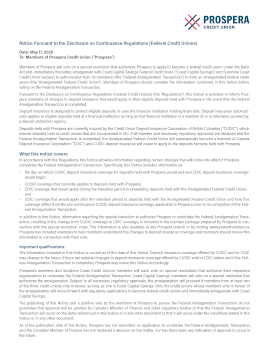
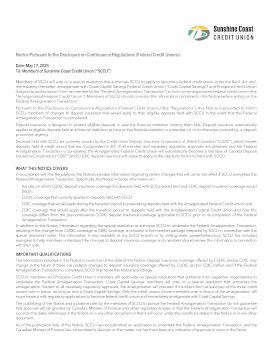
Deposits held with Prospera and Sunshine Coast are currently covered by the deposit guarantee provided by the Credit Union Deposit Insurance Corporation of British Columbia (CUDIC), providing unlimited coverage on eligible deposits. If the proposed continuance and merger is completed, Prospera and Sunshine Coast will continue federally for the purpose of completing the merger with Coast Capital, forming one combined federal credit union. The combined credit union will immediately and automatically be a member of CDIC and CUDIC deposit insurance coverage will no longer apply to eligible deposits that were previously held with Prospera and Sunshine Coast.
There are differences between CDIC and CUDIC coverage. For more information regarding changes to deposit insurance, please see the following Notices Pursuant to the Disclosure on Continuance Regulations (Federal Credit Unions) and read the FAQs.
This change will affect fewer than 5 % of Prospera’s and 10% of Sunshine Coast’s personal banking members. As of December 31, 2024, fewer than 5% of Prospera’s personal members and 10% of Sunshine Coast’s personal members had deposits exceeding CDIC deposit insurance limits.

FAQs:
Will my deposits be protected?
Yes. There are no immediate changes. Prospera and Sunshine Coast members’ deposits are protected through CUDIC until the completion of their continuance and the merger. Coast Capital member eligible deposits are currently covered by CDIC and this will continue after completion of the merger.
Prospera and Sunshine Coast will continue as federal credit unions and immediately merge with Coast Capital to create a combined federal credit union. Deposits held with the combined federal credit union will be insured by the Canada Deposit Insurance Corporation (CDIC), which provides coverage up to $100,000 per depositor, per deposit category. CDIC is the federal crown corporation that also protects eligible deposits at the major banks and Coast Capital. CDIC provides coverage for deposits in multiple categories (e.g. non-registered accounts, RRSPs, RRIFS, TFSAs, deposits held in trust and joint accounts), with coverage up to $100,000 available separately for each category per depositor.
If the continuance and merger proceeds, there will be a transition period for deposit insurance coverage provided by CDIC starting the day the transaction is completed. CDIC will provide the same coverage as CUDIC for most pre-existing deposits for a transition period starting on the day the continuance and merger is completed and ending after 180 days, in the case of demand deposits, and on the date of maturity or cashing out, in the case of term deposits. After the transition period, CDIC’s normal coverage will apply.
How does CDIC deposit insurance coverage work?
CDIC deposit insurance applies automatically and free of charge to cover eligible deposits in the very unlikely event the member institution of CDIC holding the deposit fails. We can help you maximize your deposit insurance coverage by holding funds in multiple categories.
CDIC offers $100,000 insurance per separately insured category:
- Deposits held in one name
- Deposits held in more than one name (joint deposits)
- Deposits in a trust account
- Deposits in a TFSA
- Deposits in an RRSP
- Deposits in an RRIF
- Deposits held in an RESP
- Deposits held in an RDSP
- Deposits held in a FHSA
Joint name unique combinations are insured separately (shifting the order of joint names would not be separately insured). Principal and interest are included in the amount insured.
How can I maximize my CDIC insurance?
Members can get more than $100,000 of deposit insurance coverage from CDIC by rearranging their deposits into multiple categories. The amount of CDIC coverage available to an individual will depend on their circumstances and the types of accounts they hold. For example, one person can obtain up to $500,000 of coverage for their eligible deposits by putting money in non-registered accounts, RRSPs, TFSAs, RESPs and FHSAs. If this person has a spouse, the spouse will have the same amount of coverage available separately. Additional coverage of up to $100,000 will be available if they place eligible deposits in a joint account. More coverage could be available depending on family circumstances and preferences.
Before making any changes to the structure and ownership of your deposits, we recommend having a discussion with an advisor. Deposit insurance is just one factor to consider when determining the best way to structure your deposits. Changes made to maximize deposit insurance coverage may have impacts on estate planning, tax efficiency and other investment goals, so it is important to work with an advisor to holistically review your financial goals and ensure changes you may be considering do not negatively impact other aspects of your financial plan.
I currently have deposit accounts with two or more of Coast Capital, Prospera and Sunshine Coast in the same CDIC category (e.g. non-registered deposits in one name). If the continuance and the merger happens, will there only be one $100,000 insurance limit for all accounts in the same category?
If a member holds eligible deposits with two or more of Coast Capital, Prospera and Sunshine Coast on the date of the merger that remain on deposit with the combined federal credit union, these deposits, less any withdrawals, will be treated as separate deposits, each with separate coverage per category up to CDIC’s insurance limit for two (2) years following that date, in the case of demand deposits, and until maturity or cashing out, in the case of term deposits. After this period, a single $100,000 CDIC insurance limit per category per registration will apply across the combined federal credit union.
Are my term deposits covered until the end of the term?
Yes. Following completion of the continuance and merger, CDIC will offer transitional coverage for eligible pre-existing term deposits previously held with Prospera and Sunshine Coast credit unions. Eligible term deposits that members have with Prospera or Sunshine Coast that are still outstanding on the closing date of the merger will continue to have unlimited deposit insurance until the end of the term or until they are cashed out.
What about my other deposits that are not held in terms?
Following the completion of the continuance and merger, CDIC will offer transitional coverage for existing eligible demand deposits (e.g. chequing and savings accounts) previously held with Prospera and Sunshine Coast credit unions. The transition period lasts for 180 days, during which CDIC protection will apply to eligible deposits made before the transition.
Can you provide an example of how the changes in deposit insurance will work?
Immediately before the date that Prospera and Sunshine Coast credit unions complete their continuance and merge with Coast Capital to form the combined federal credit union (“the continuance and amalgamation day”), Paul is a member of either Prospera or Sunshine Coast and has the following products with that credit union:
| Amount | Amount Insured by CUDIC | |
| Chequing Account | $5,000 | $5,000 |
| Savings Account | $45,000 | $45,000 |
| Term Deposit (3 year) | $75,000 | $75,000 |
| RRSP Term Deposit (5 year) | $175,000 | $175,000 |
| Mortgage | ($250,000) | Not eligible |
| RRSP Mutual Fund Investment | $80,000 | Not eligible |
Starting on the continuance and amalgamation day and for the first 180 days after continuance and amalgamation day:
- All of Paul’s pre-existing demand deposits, minus any withdrawals he makes, will be fully insured by CDIC.
- All of Paul’s pre-existing term deposits will be fully insured until the date of maturity or they are cashed out.
| Amount | Amount Insured by CDIC | |
| Chequing Account | $5,000 | $5,000 |
| Savings Account | $45,000 | $45,000 |
| Term Deposit (3 year) | $75,000 | $75,000, until maturity |
| RRSP Term Deposit (5 year) | $175,000 | $175,000, until maturity |
| Mortgage | ($250,000) | Not eligible |
| RRSP Mutual Fund Investment | $80,000 | Not eligible |
- Any new deposits Paul makes are separately insured by CDIC in accordance with its standard coverage.
On the 181st day following continuance and amalgamation day:
- Paul’s demand accounts will be covered in accordance with CDIC’s standard coverage.
- Paul’s term deposits will be fully insured until the date of maturity, or they are cashed out.
| Amount | Amount Insured (before term deposits mature) | Amount Insured (after term deposits mature) |
|
| Chequing Account | $5,000 | $50,000 | $100,000 (aggregate total coverage for all 3 accounts) |
| Savings Account | $45,000 | ||
| Term Deposit (3 year) | $75,000 | $75,000, until maturity | |
| RRSP Term Deposit (5 year) | $175,000 | $175,000, until maturity | $100,000 |
| Mortgage | ($250,000) | Not eligible | Not eligible |
| RRSP Mutual Fund Investment | $80,000 | Not eligible | Not eligible |
After the transitional coverage ends, some of Paul’s deposits would exceed CDIC’s coverage limits. However, we can help to provide strategies that could help Paul maximize his coverage. For example, in Paul’s case he could obtain additional coverage by putting some of his money in a TFSA, RESP or FHSA. Another thing Paul could do is put some of his money in a joint account with his spouse.
How is my business account covered?
For the purposes of deposit insurance, a depositor may be an individual, an association of persons, a partnership, a corporation or a government entity. Eligible deposits in business accounts may be insurable separately from eligible deposits in individual accounts. Sole proprietorships do not benefit from separate deposit protection, as they are not separate legal entities. As a result, deposits in the individual’s name will be combined with the sole proprietor’s personal deposits.
In terms of my deposits, are there benefits to federal regulation?
Federally regulated credit unions are governed by and organized under the Canadian Federal Bank Act and regulated by OSFI. Compliance with federal financial consumer protection legislation is overseen by the Financial Consumer Agency of Canada. Deposit insurance is provided by CDIC. This is the same regulatory framework that applies to Canada’s largest banks.
Canada’s financial system is regarded as one of the safest and strongest in the world. The federal regulatory framework and supervision play an important role in promoting and contributing to financial stability and public confidence and, in particular, supporting depositors to have confidence that their deposits are safe.